281 | Milkflower
FILED UNDER: THE MOONLIT CONSERVATORY
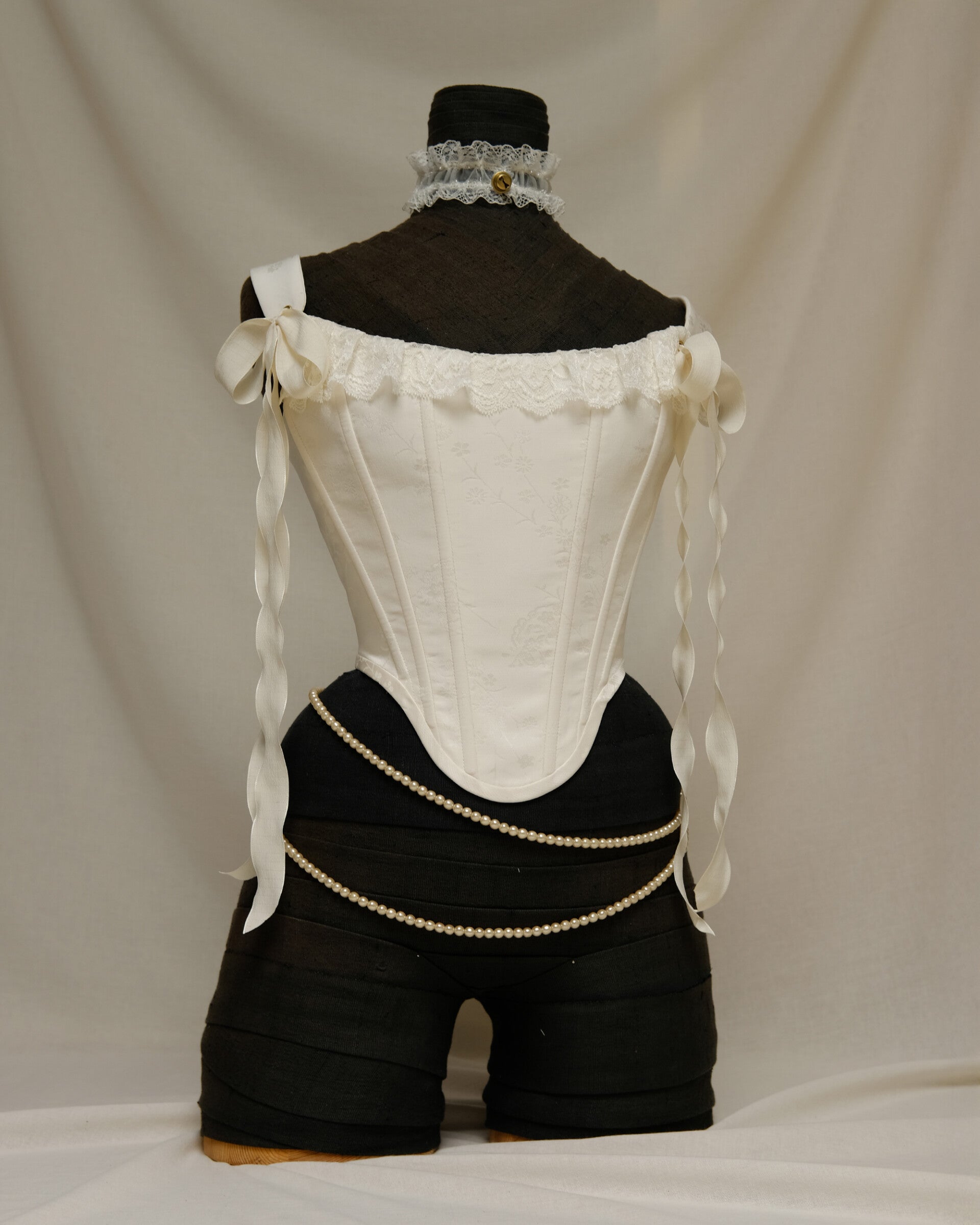
Recovered from the ivy the morning after a bloom no one was awake to see. A few pale petals remained among the leaves. No trace of the flower itself was found.
SHELL
Ivory silk damask, reclaimed from the lining of a kimono and woven with a delicate, almost hidden floral pattern. Both faces of the fabric are used in this piece. Era: provisionally dated to the 1980s.
LINING
Crisp, undyed cotton.
DETAILING
Scalloped lace along the neckline.
STRUCTURE
11-panel construction reinforced with synthetic whalebone. The softly pointed hem creates an elongated line through the torso.
LACING
Soft milky ribbon threaded through reinforced gold-tone grommets.
SIZE
S [size guide]
EDITION
One of one.
FROM THE CITY ARCHIVES
The Moonlit Conservatory
The Moonlit Conservatory occupies the oldest glasshouse in the northern gardens of the City. Its collection is kept primarily for evening flowering plants, pale foliage, climbing vines, and flowers that open only after sunset. The glass panes are rarely uncovered at night, and the interior is lit by low lamps rather than electric fixtures.
The Conservatory has long been used as a place to receive visitors after dark. Its attendants maintain a small collection of garments for guests who remain until morning, particularly during the warmer months when the doors between the dressing rooms and gardens are left open.
Milkflower is recorded among these garments, although the surviving documentation is incomplete. The earliest entry consists of the name, a date, and a single handwritten notation: “Returned before dawn.”
No record identifies a wearer.
The garment is associated with the Conservatory's night collection, and the pale colouring of the silk has led to its continued use during evening gatherings. The floral pattern woven into the damask is visible only at certain angles, becoming more apparent as the fabric moves through the low light of the glasshouse.
The name Milkflower appears in the earliest surviving record and has been retained.


